Computer Aided Engineering (CAE)
IBM Power servers deliver a winning combination of speed, flexibility, and reliability that makes them the best choice for the most demanding applications, especially for computational fluid dynamics and finite element simulations. No server continually delivers value to your business like IBM Power does. CPUs and showed superior performance with Power10.
MASSIVE BANDWIDTH WITHOUT COMPROMISING CAPACITY
In recent years, the simulations engineers rely on, especially structures and CFD, are bandwidth-bound, meaning the full power of the processor can’t be unlocked due to insufficient memory throughput. This has driven many simulations to GPUs, where high bandwidth unlocks more performance, but at the cost of very little memory capacity for large simulations.
IBM Power offers the best of both worlds. With up to 32 channels of memory per socket, a Power CPU offers as much as three times the bandwidth of x86 or Arm processors, which typically have 8 to 12 channels. And while few GPUs offer significantly more than 100 GB of RAM, a Power server can host up to 16,384 GB of RAM, easily enough for the largest, most complex workloads.
With up to 960 hardware threads per server, each thread with its own floating-point unit, there’s enough performance available to deliver fast turnaround time on simulations.

THE POWER OF UPTIME
When a server fails in the middle of a large simulation, hours or even days can be lost as the simulation must be restarted, sometimes going to the back of the queue.
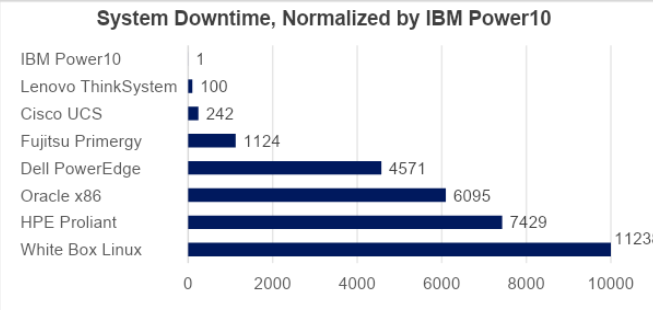
IBM Power servers are the most reliable in the business, delivering the highest server uptime of any computer on the market. Moreover, zero-overhead security means you can unleash the full performance of your system without the risk of your system being compromised by attackers.
HIGH PERFORMANCE COMPUTING FOR MECHANICAL SIMULATIONS
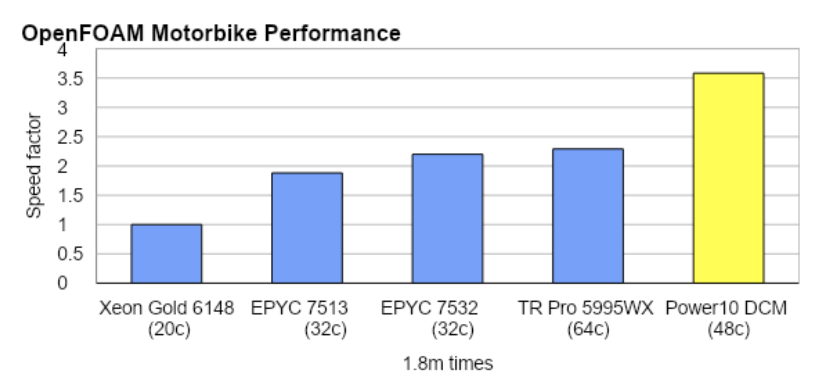
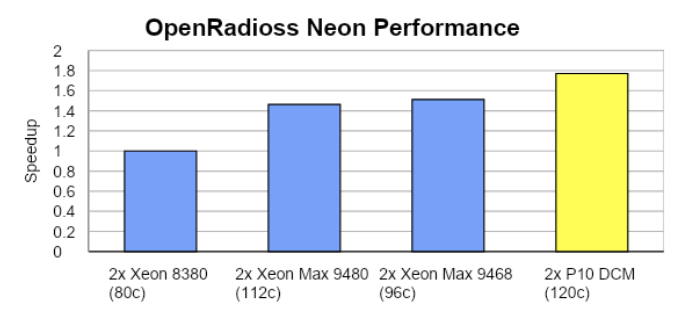
In addition to their history as rock-solid business machines, IBM Power servers draw on a legacy of record-setting supercomputers to deliver performance at a combination of scale and reliability unmatched by anything on x86. We’ve benchmarked some popular open-source CAE codes to demonstrate the performance of Power10. OpenFOAM is a popular CFD code used widely in academia and industry for aerodynamics, hydrodynamics, and more. OpenRadioss is a finite element solver commonly used in crash simulations and other structural applications. Power10 demonstrated excellent performance in both codes. Combined with its industry-leading security and reliability, it is an excellent choice for CAE workloads.
BENEFITS OF IBM POWER
- Designed to last decades
- Thermally Engineered for Consistent Performance
- High Memory Bandwidth
- Best-in Class Service
- Support for Standard Linux
- Consistent uptime